
TL;DR — the new fiscal year in one minute
• The whole year is shaped in April. The first 30 days of new FY set your tax, cash and compliance rhythm.
• Lock your tax regime early. The new regime under Section 115BAC is the default, and income up to ₹12 lakh is effectively tax-free.
• Close previous FY cleanly first. Miss the MSME 45-day payment rule under Section 43B(h) and you lose the deduction.
• Build a bottom-up budget and a 13-week rolling cash-flow model — weekly cash is reality, annual plans are theory.
• Track a tight set of monthly KPIs, refresh your insurance, and follow the latest FY compliance calendar so no deadline surprises you.
The success of the FY is decided in April. Founders who treat the first month as a slow patch spend the rest of the year fighting cash-flow fires instead of scaling.
Within the first 30 days — 1 April to 30 April — you should declare your tax regime, pass the final closing entries for the old year, reconcile GST, get a board-approved budget, and switch on a monthly KPI dashboard. That is the whole playbook in one sentence.
None of this is glamorous. But a founder who front-loads these decisions buys a calmer, more predictable year. If you want a second set of hands on the numbers, a virtual CFO can run this April sprint with you.
 Founder tip: Block a half-day in the first week of April purely for finance. Treat it like a board meeting with yourself. The hour you spend planning now saves ten hours of firefighting later.
Before you plan the new year, cleanly close the old one. These seven entries are the ones the Income Tax Department scrutinises most, and the ones founders most often forget.
Closing entry | What to do |
Section 32 depreciation | Apply the block-of-assets calculation to all capex bought during the year |
Prepaid & accrual cutoffs | Split software and subscription costs that bridge March and April correctly |
GST reverse charge (RCM) | Pay and claim RCM on eligible March vendor invoices |
TDS true-up | Match your books precisely with Form 26AS and the AIS |
Section 43B(h) MSME | Disallow expenses for micro and small vendors left unpaid beyond the limit |
ESOP charge | Book the non-cash ESOP expense as required under the accounting standards |
Leave encashment | Provide for the accrued, unused leave balances of your team |
Get these right and your books tell the truth. Get them wrong and you carry errors into the new year. If closing feels heavy, your accounting and compliance team should own this list.
You must decide the TDS structure for your own salary and tell HR by mid-April. The choice sits between two regimes.
New regime (Section 115BAC): now the default. Income up to ₹12 lakh is effectively tax-free thanks to the Section 87A rebate, and salaried people also get a ₹75,000 standard deduction. But it drops most exemptions like HRA, LTA and Section 80C.
Old regime: still worth it if you have a large home-loan interest claim under Section 24(b), combined with fully used 80C, 80D health cover and heavy HRA.
 Watch out: If you have business income and want to opt out of the default new regime, you must file Form 10-IEA before your return due date. Miss it and you are stuck on the new regime for the year. Confirm current slabs on the Income Tax Department portal.
The lazy budget copies last year and adds a flat percentage. The useful budget is built line by line from the ground up.
Set gross-margin targets: a rough guide is 70%+ for SaaS, 35–50% for D2C brands, and 40–55% for IT services.
Split opex line by line: separate fixed costs like rent and base payroll from variable costs like marketing spend and cloud hosting.
Provision for tax monthly: year-end compliance eats cash. Set aside roughly a quarter of projected profit each month in a separate account for advance tax.
A budget you build bottom-up becomes a plan you actually believe. It also becomes the yardstick you measure every month against.
Indian banks and investors reward capital efficiency. So build two cash models, not one.
The 13-week forecast: a granular, week-by-week view of exactly what cash comes in from receivables and goes out on payroll and vendors over the next quarter.
The annual view: the same picture stretched across the year, so you can see funding gaps months before they arrive.
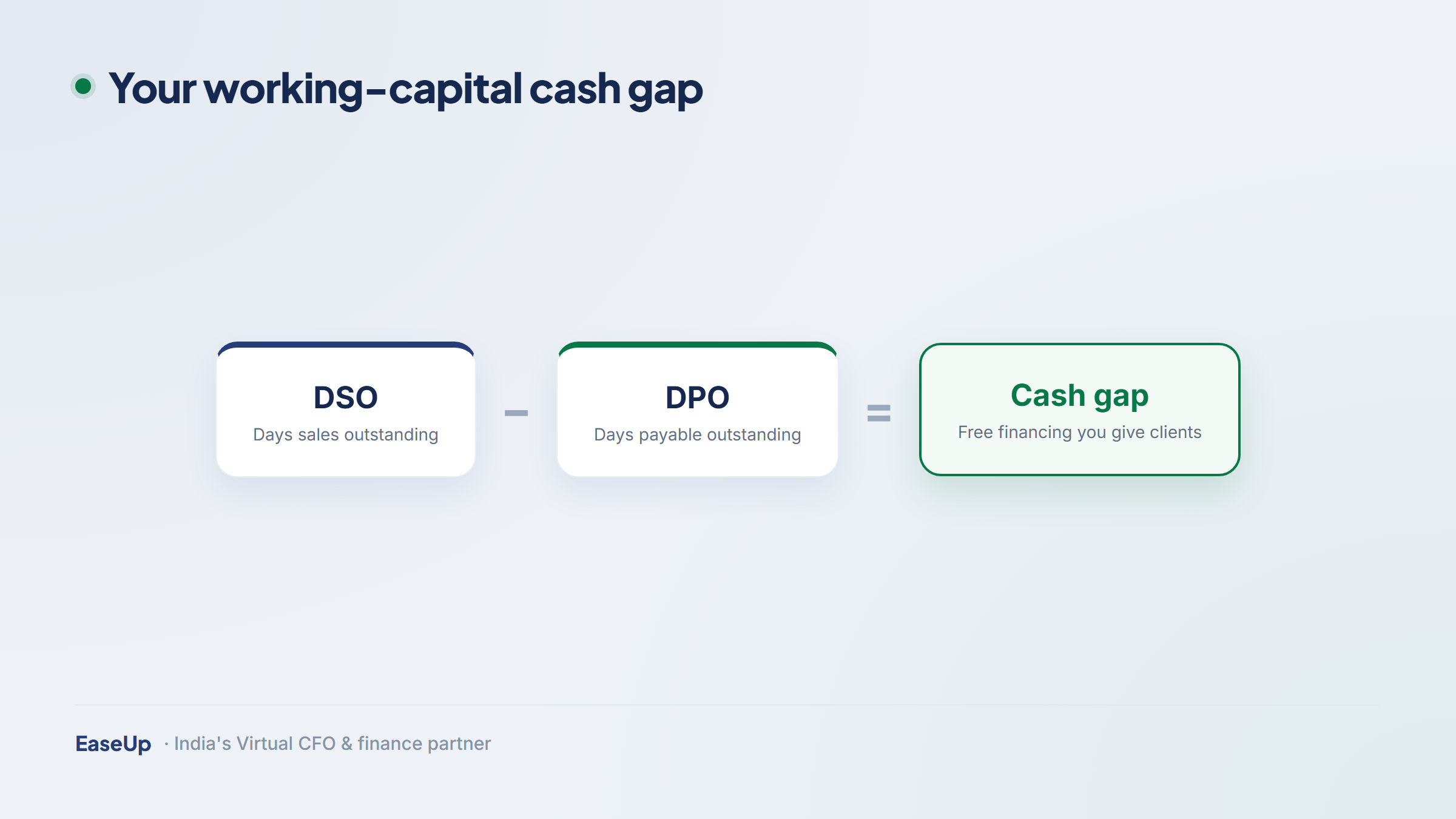
Watch your working-capital cycle too. It is your DSO (days sales outstanding) minus your DPO (days payable outstanding). If your DSO drifts past 60 days, you are quietly financing your customers for free.
:info: Why 13 weeks: A quarter is close enough to forecast accurately and long enough to act. Annual budgets are theoretical. A rolling 13-week cash view is the reality you steer by every Monday.
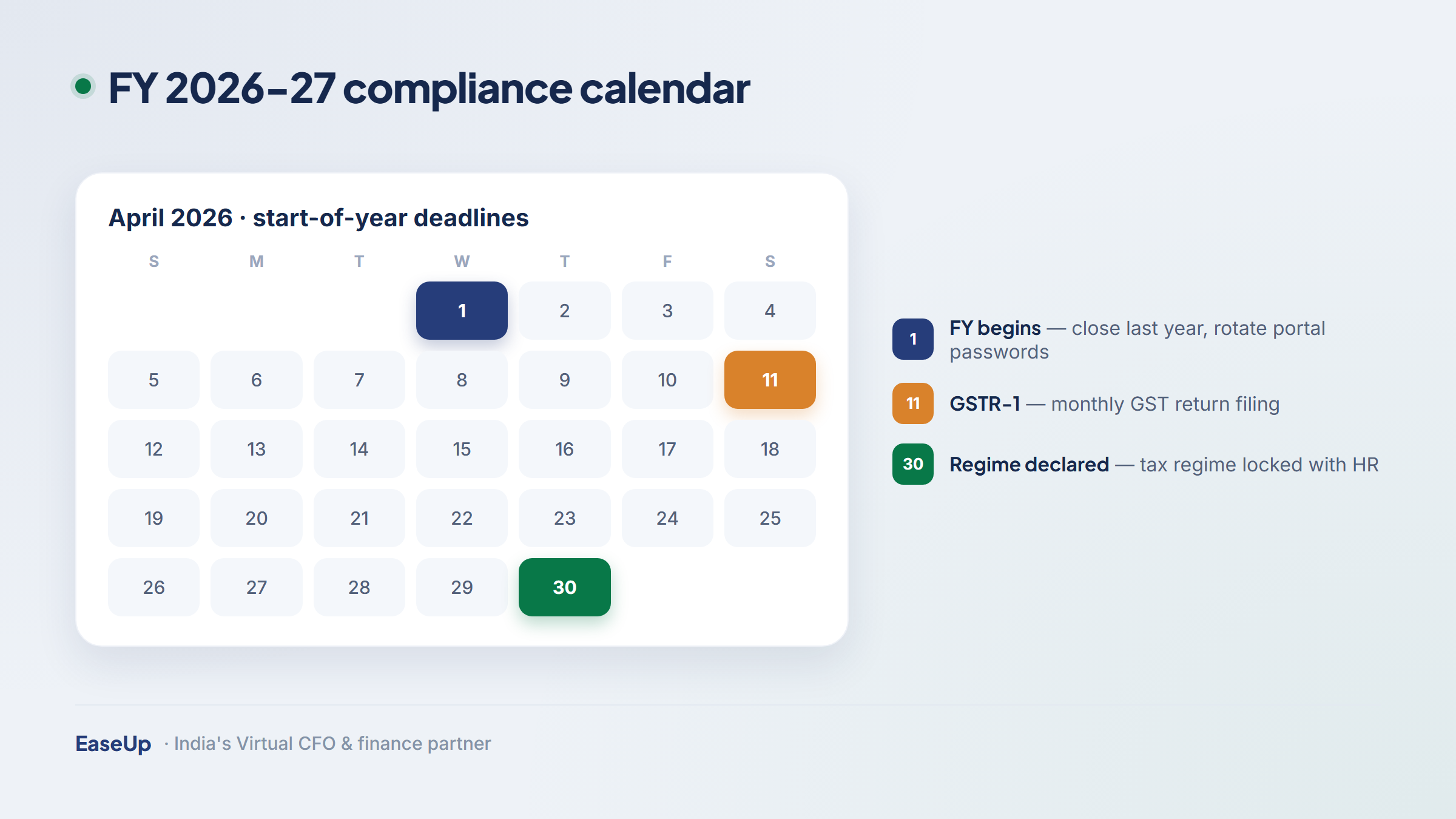
Print this and stick it on your wall. Missing a statutory date costs interest, penalties and stress you can avoid.
When | What is due |
April | Tax regime declarations; monthly GSTR-1 filing |
15 June 2026 | First advance-tax instalment (15%); Form 16 issuance |
15 September 2026 | Second advance-tax instalment (cumulative 45%) |
30 September 2026 | DIR-3 KYC of directors; AGM for companies |
31 October 2026 | ITR filing for audit cases |
29 November 2026 | MCA Form MGT-7 (annual return) |
15 December 2026 | Third advance-tax instalment (cumulative 75%) |
31 December 2026 | GSTR-9 annual return |
15 March 2027 | Final advance-tax instalment (cumulative 100%) |
Director KYC and annual filings live on the Ministry of Corporate Affairs portal, while the GSTR-9 is filed on the GST portal. Diary these dates the day the year begins.
Your monthly MIS should not drown you in numbers. Track a tight set of eight and you will spot trouble early.
KPI | Rough target for Indian SMEs |
Gross margin % | Is the core product actually profitable? |
EBITDA margin | 10–25%, depending on sector maturity |
CAC payback | Under 18 months |
Cash runway | More than 12 months |
DSO / receivables ageing | Under 60 days |
Current ratio | Above 1.5x |
GST ITC utilisation % | Claim the input credit you are owed |
MSME ageing over the limit | Zero, to avoid Section 43B(h) penalties |
These eight tell you whether you are profitable, liquid and compliant at a glance. When wealth and reserves start building, a wealth management plan helps you put idle cash to work rather than letting it sit.
If you plan to buy machinery, servers or office space this year, do not pay full freight. India has schemes built to help.
Section 35AD: a 100% capital deduction for specified businesses such as cold-chain and hospitals.
CGTMSE credit guarantee: collateral-free working-capital or capex loans up to ₹10 crore, backed through SIDBI and major banks.
Accelerated depreciation: buy and put an asset to use before 30 September to claim the full-year depreciation, not the half-year rate.
DPIIT-recognised startups can also unlock extra reliefs. Check what you qualify for on the Startup India portal.
Founder tip: Timing matters as much as the purchase. An asset bought on 29 September and one bought on 2 October can differ by half a year of depreciation on your tax bill. Plan large buys around that date.
Section 43B(h) is the trap founders trip over most. If a micro or small vendor supplies you, you must pay them within 45 days where there is a written agreement, or 15 days where there is none.
Miss that window and the expense is disallowed for the year. You cannot claim the deduction until the year you actually pay. Habitually late payments can quietly wreck your whole tax plan — and add interest on top.
Watch out: Track your MSME payables ageing every single month, not just at year-end. By 31 March it is too late to fix an overdue invoice. This is the single easiest way to lose a deduction you were entitled to.
Insurance is often the last thing a founder thinks about, right until disaster strikes. Renew and review three covers early.
D&O (directors & officers): effectively mandatory once you have investor board members.
Cyber insurance: increasingly important given the stiff penalties under the Digital Personal Data Protection Act.
Group health: review premiums early, as medical inflation tends to push renewals up each year.
Day 1–5: circulate tax-regime declaration forms to the team, and rotate passwords on the GST and MCA portals.
Day 6–15: lock all March closing entries, and run the first payroll on the new TDS slabs.
Day 16–25: finalise the annual operating plan and present the bottom-up budget to your board for approval.
Day 26–30: deploy the new monthly MIS dashboard so the team starts the year measuring what matters.
This April sprint touches tax, cash, compliance and strategy at once. That is a lot for a founder already running the business. If you are modelling runway, building the budget, or preparing for an audit, expert help pays for itself.
A virtual CFO brings the discipline of a bottom-up budget, a live cash forecast and a clean compliance calendar — so you enter the year in control, not in catch-up.
Start by cleanly closing the previous year, then declare your tax regime, build a board-approved bottom-up budget, and deploy a monthly KPI dashboard. In practice, aim to finish all of this within the first 30 days of April, because the decisions you make then set the tone for the whole year.
The new regime under Section 115BAC is the default, and income up to ₹12 lakh is effectively tax-free thanks to the Section 87A rebate, plus a ₹75,000 standard deduction for salaried people. The old regime can still win if you have a large home-loan interest claim combined with fully used 80C, 80D and HRA benefits. Do the maths for your own numbers.
Section 43B(h) says payments to micro and small enterprises must be made within 45 days where there is a written agreement, or 15 days where there is none. If you pay late, the expense is disallowed for that year and the deduction is only allowed in the year you actually pay. Track your MSME payables every month to avoid losing deductions.
A 13-week rolling forecast tracks exactly what cash comes in and goes out, week by week, over the next quarter. It is short enough to be accurate and long enough to act on. Annual budgets are theoretical, but a weekly cash view is the reality you steer by, and it warns you about funding gaps before they hit.
Advance tax is paid in four cumulative instalments: 15% by 15 June 2026, 45% by 15 September 2026, 75% by 15 December 2026, and 100% by 15 March 2027. Setting aside roughly a quarter of your projected profit each month into a separate account makes these payments far easier to meet.
This guide is for general information only and does not constitute tax, legal or financial advice. Rules, slabs and due dates change — confirm the current position with a qualified professional before you act on your fiscal-year plan.


Your trusted partner for all your Financial needs.


Finance Management
Strategic Services