
TL;DR — Financial management for startups in one minute
• Startups rarely die from bad ideas. They die from poor cash visibility — "ran out of money" tops most failure lists, but it is a symptom of weak planning underneath.
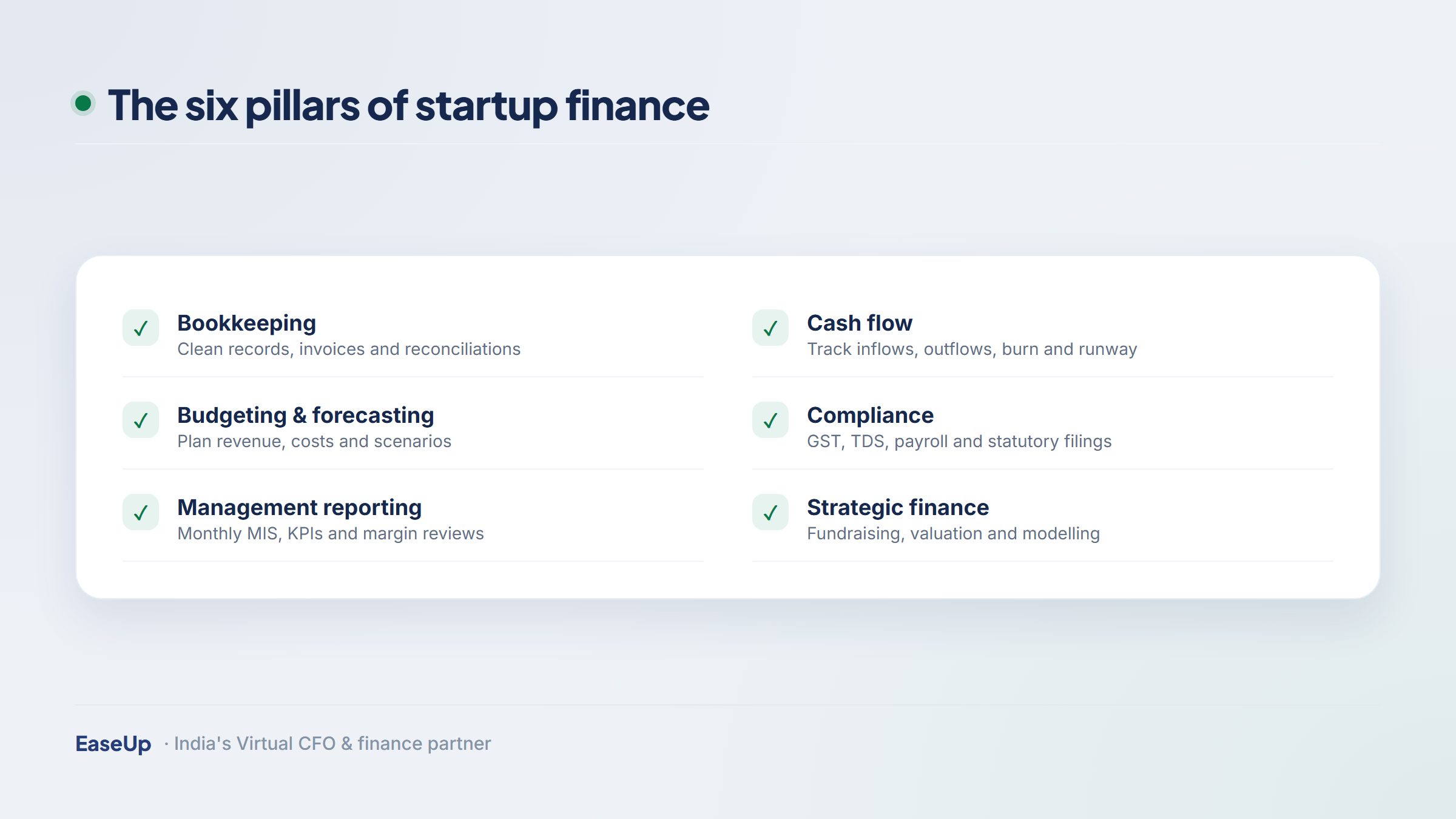
• Think in six pillars: bookkeeping, cash flow, budgeting and forecasting, compliance, management reporting, and strategic finance.
• The five core functions of financial management are planning, analysis and control, investment decisions, financing decisions, and risk management.
• Watch cash, not just revenue. Profit on paper does not pay salaries — runway does.
• You do not need a full finance team on day one. A virtual CFO gives you senior financial leadership on a flexible, part-time basis.

Startups rarely fail for lack of a good idea. They fail because the numbers are unclear, cash runs tight, compliance slips, or big decisions get made without reliable financial visibility. Financial management for startups is not a back-office chore — it is a growth function.
The data is blunt. When founders study why startups shut down, "ran out of cash" sits near the top of almost every list. But that is usually the final cause of death, not the root problem. Cash dries up because pricing, unit economics or spending discipline were never controlled. Nearly nine in ten startups do not survive their first five years, and the median gap between the last fundraise and shutdown can be under two years.
Good financial management flips that story. It helps you track where money comes from and goes, extend your runway, stay compliant, report credibly to investors, and make confident calls on hiring, pricing and expansion. If your finance setup still runs on scattered spreadsheets and delayed reports, it is time to strengthen it before the next big decision.
 Founder tip: Do not wait for a crisis to look at your numbers. Block one hour every month to review cash, burn and runway. Founders who review monthly make earlier, calmer decisions than those who only look at year-end.
At its simplest, financial management is the process of planning, organising, controlling and monitoring your money so the business can meet its obligations, reduce risk and grow profitably. It runs from budgeting and cash tracking through to reporting, forecasting, compliance and strategic decisions.
Done well, it turns numbers into decisions. It answers the questions that keep founders up at night:
Are we actually profitable after every cost is counted?
Do we have enough cash to cover the next three to six months?
Which products, clients or channels generate the best margins?
Are we ready for tax, audit and investor scrutiny?
Can we hire, expand or invest without putting the business under pressure?
You do not need a finance department on day one, but you do need structure. These six pillars create it.
Pillar | What it covers | Why it matters |
Bookkeeping | Recording income, expenses, invoices and reconciliations | Keeps the financial foundation accurate |
Cash flow | Tracking inflows, outflows, burn and runway | Prevents liquidity shocks |
Budgeting & forecasting | Planning revenue, costs and future scenarios | Supports smarter, calmer decisions |
Compliance | GST, TDS, payroll, filings and statutory deadlines | Reduces penalties and disruption |
Management reporting | Monthly MIS, KPIs, margins and trend reviews | Gives founders real visibility |
Strategic finance | Fundraising prep, valuation, diligence and modelling | Supports scale and investor readiness |
Founders routinely underestimate the damage bad bookkeeping causes. When entries are delayed or reconciliations are incomplete, every report built on that data becomes unreliable — your forecast, your MIS, your investor deck, all of it.
Strong bookkeeping keeps books clean, reconciles accounts fast and kills month-end confusion. It gives you confidence that the numbers you review actually reflect the business. Get this right first; everything else in financial management sits on top of it.
Revenue growth can look impressive and still hide trouble. If collections are slow, costs climb faster than expected, or inventory locks up capital, a "growing" startup can still hit a cash wall. That is why cash flow, not revenue, is the number to watch.
Your most important cash metric is runway — how many months you can operate before the money runs out. The maths is simple:

Say you hold ₹60,00,000 in the bank and your net burn is ₹5,00,000 a month. Your runway is (₹60,00,000 ÷ ₹5,00,000) = 12 months. Good cash flow management answers the hard questions early: how many months do we really have, which costs are fixed versus variable, and are receivables turning into cash fast enough?
 Watch out: Profit is an opinion; cash is a fact. Your P&L can show profit while your bank balance shrinks — because of delayed collections, upfront inventory or advance tax. Never manage runway off the profit line alone.
A budget is not paperwork for the accountant. It is an operating plan that aligns hiring, marketing spend, vendor commitments and product bets with what the business can actually afford.
A simple, useful startup forecast includes:
Expected monthly revenue by product, service or channel.
Payroll and operating costs, split into fixed and variable.
Tax obligations and capital expenditure plans.
Three scenarios: best case, expected, and downside.
Reviewed consistently against actuals, a forecast lets you spot gaps early and adjust before problems get expensive. Budgets are only as good as the numbers behind them, which is exactly why disciplined monthly accounting matters so much.
Zoom out from startups to any business, and financial management breaks into five interconnected functions. Each one supports better control and stronger decisions.
Function | Primary goal | Key question it answers |
Planning & budgeting | Set financial direction | What are we aiming for, and what will it cost? |
Analysis & control | Measure performance | Are we on plan, and where are the gaps? |
Investment decisions | Allocate capital wisely | Which opportunities create the best return? |
Financing decisions | Choose the right funding mix | Equity, debt or internal cash — which and when? |
Risk management | Protect business stability | What could go wrong, and how do we cut the downside? |
Financing and investment decisions get sharper when they sit alongside your fundraise and cap-table strategy. Choosing debt over equity, or delaying a hire by a quarter, can change your ownership and runway more than any single sales month.
For startups, compliance is easy to postpone and costly to ignore. Missed filings, weak documentation or messy payroll invite penalties and notices at the worst possible time. The fix is a predictable monthly rhythm — not a scramble at year-end.
Obligation | Typical due date (each month) |
TDS deposit | By the 7th of the following month |
GSTR-1 (outward supplies) | By the 11th |
PF & ESIC contributions | By the 15th |
GSTR-3B (summary return & GST payment) | By the 20th |
MSME vendor payments | Within 15 days (no written agreement) or 45 days (with a written agreement), for Micro & Small suppliers. Miss it and the expense is disallowed for that year. |
Dates shift with turnover, scheme and notifications, so confirm the current position on the GST portal and the Income Tax Department portal. Payroll statutory dues are managed through the EPFO portal. The goal is not just filing on time — it is being permanently ready for scrutiny from a lender, investor or authority.
:info: The MSME payment rule (Section 43B(h)): If you buy from a Micro or Small enterprise registered on the Udyam portal, pay within 15 days — or up to 45 days if you have a written agreement setting the credit period. If the amount is still unpaid on 31 March, it's disallowed as a deduction that year and only becomes deductible in the year you actually pay — quietly inflating your current-year tax bill. The rule covers manufacturers and service providers, not traders, and doesn't apply to Medium enterprises.
Monthly reports should not be long, jargon-heavy or late. They should help you answer practical questions: are we growing profitably, which costs are rising too fast, where is working capital getting stuck, and which products or channels actually make money?
That is the job of a good MIS and management reporting setup. With disciplined monthly reporting you review performance in real time instead of waiting for year-end surprises — and that shift alone lifts decision quality across the whole business.
As you grow, finance has to move beyond compliance into strategy — fundraising prep, board reporting, financial models, expansion analysis and sharper unit economics. That is senior, expensive work.
You rarely need a full-time CFO at this stage. A virtual CFO gives you experienced financial leadership on a flexible basis: the cap-table discipline, forecasting rigour and investor-grade reporting, without a full-time senior salary on your runway.
Your finance needs change as you scale. Over-build too early and you waste cash; under-build and you fly blind.
Early stage: clean books, basic compliance and simple cash tracking. Bookkeeping plus monthly reporting is enough.
Growth stage: budgeting, MIS, process discipline and better visibility. Bring in structured monthly finance management.
Fundraising stage: a financial model, diligence support and investor-ready reporting. This is where a virtual CFO earns its keep.
Most founders do not spot a finance problem until it hits liquidity or compliance. Watch for these signs.
Warning sign | What it usually means | Business impact |
Profitable but often short on cash | Collections or working capital are poorly managed | Operational stress and delayed payments |
You do not review numbers monthly | Reporting is inconsistent or not decision-ready | Slow, reactive decisions |
You cannot explain margin by product | Cost tracking is incomplete | Revenue grows but profit stays weak |
Tax work happens at the last minute | Finance processes are not structured | Higher risk of penalties and errors |
Forecasts are based on guesswork | No real budgeting or scenario planning | Over-expansion and poor capital allocation |
Chasing revenue while ignoring cash — celebrating sales that have not been collected.
Confusing profit with liquidity — assuming a profitable P&L means money in the bank.
Postponing compliance until a notice or penalty forces the issue.
Hiring a full-time CFO too early, burning runway on a role a virtual CFO could cover.
Never reviewing the budget against actuals, so the plan drifts from reality.
None of these are hard to avoid. They come down to a simple habit: look at reliable numbers, regularly, and act on what they say. If that habit is missing, a finance partner can install it for you. Startups can check recognition and benefits on the Startup India portal, and company filings on the MCA portal.
Resilience is not about spending more on finance. It is about a few disciplines done consistently: clean books, a live cash forecast, a monthly review rhythm, on-time compliance, and honest scenario planning. Put those in place and expansion becomes deliberate instead of risky.
When the numbers are clear, decision-making gets faster and calmer. You act on evidence, not assumptions — which is the whole point of financial management for startups.
Financial management for startups is the process of planning, organising, controlling and monitoring a young company’s money so it can meet obligations, reduce risk and grow profitably. It spans bookkeeping, cash flow, budgeting and forecasting, compliance, management reporting and strategic finance. For founders, it is less about accounting and more about turning numbers into faster, more confident decisions on hiring, pricing and expansion.
There are five core functions. Planning and budgeting set the financial direction. Analysis and control measure actual performance against the plan. Investment decisions allocate limited capital to the best-return opportunities. Financing decisions choose the right mix of equity, debt and internal cash. Risk management protects stability by spotting problems such as cash gaps or compliance exposure early. Together they support control, better decisions and sustainable growth.
Profit is an accounting result; cash is what actually pays salaries, vendors and taxes. A startup can be profitable on paper yet run out of money because collections are delayed, costs rise, or inventory ties up capital. Runway — cash in bank divided by monthly net burn — tells you how many months you can operate. Managing cash flow, not just revenue, is what keeps a startup in control during uncertainty.
Consider a virtual CFO when finance work moves beyond basic compliance into strategy — preparing a fundraise, building a financial model, improving board reporting, or making major expansion and capital decisions. A virtual CFO gives you experienced financial leadership on a flexible, part-time basis, so you get senior rigour without paying a full-time CFO salary that would eat into your runway.
The recurring monthly ones matter most: deposit TDS by the 7th, file GSTR-1 by the 11th, pay PF and ESIC by the 15th, and file GSTR-3B with GST payment by the 20th. Payments to MSME-registered vendors must be made within 45 days or the expense is disallowed. Exact dates vary by turnover and scheme, so always confirm the current position on the official GST and Income Tax portals.
This guide is for general information only and does not constitute financial, tax or legal advice. Rules, deadlines and thresholds change — confirm the current position with a qualified professional before making decisions for your business.


Your trusted partner for all your Financial needs.


Finance Management
Strategic Services